
November 2026
Plenty of houses with a steep main roof also carry a section that is almost flat: a back porch, a carport, an addition, the strip of roof behind a dormer. Those pieces get looked at less and leak sooner. Here is why they fail first, and how to tell when yours has started.
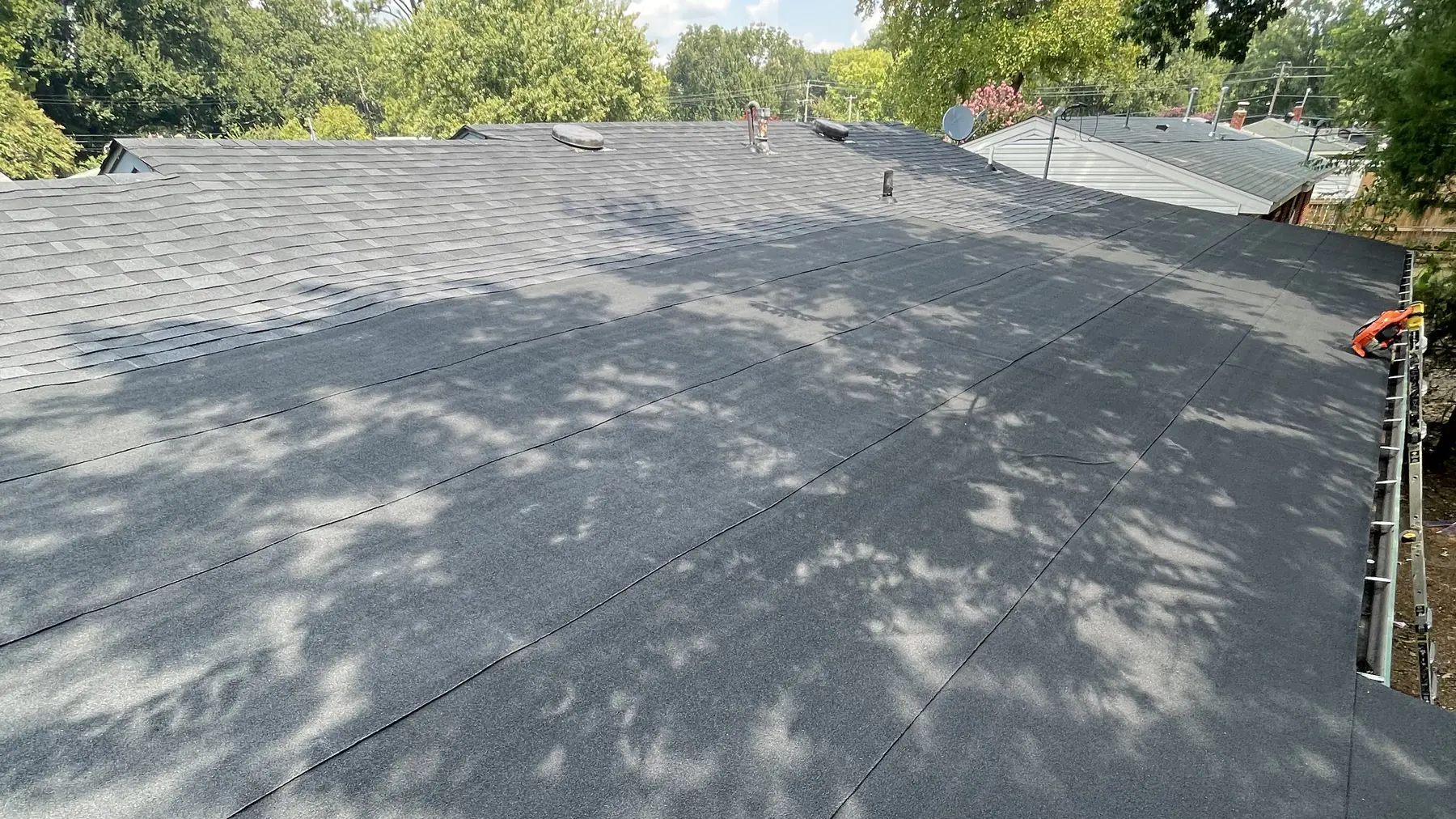
Why the flat part fails first
A shingle sheds water because gravity pulls it over the lap before it can work backward. Take most of the pitch away and water lingers, wind pushes it uphill under the laps, and a shingle that behaves on the main roof turns into a leak waiting for a heavy rain.
Low slope sections need a membrane.
Plenty of them got shingles anyway, because shingles were on the truck that day. Shingle makers set a minimum pitch for their product, and a lot of porch roofs sit below it.
Even a proper membrane has a harder life down there. Water sits in any shallow dip, leaves and pollen gather where it sits, and every seam spends more hours wet than a seam on a steep slope ever will.
So when one leak keeps coming back over the same room, the low piece of roof above that room is the first place we look.

Where low slope meets the taller wall
The weak point is rarely the middle of the flat section. It is the edge where that section runs into something taller: the brick of the house, the siding on an addition, the face of a dormer. All the water coming off the main roof lands right there.
That joint lives or dies on its flashing.
Caulk smeared over a gap, where there should be metal tucked behind the siding or cut into the mortar, holds for a summer or two and then quits.
Behind a dormer or a chimney, the low strip can trap water on the uphill side, and with heavy tree cover the debris piled against it is never small. A leak there tends to show on the wall below instead of the ceiling, which sends people hunting in the wrong room.
Additions add a second trap. The new roof was tied into the old one years after the house went up, often by a different crew, and that tie in is the first seam we pull back.
How to tell one has started
From below, look at the porch or carport ceiling. Beadboard and painted plywood show water as dark lines along the joints, paint bubbling or peeling in one area, or a board that has begun to sag between its nails.
From above, look two days after a rain. Water still sitting on the flat part by then means the deck has dipped or the edge cannot drain. Blisters in the membrane, seams with curled edges and moss growing in a corner all point the same direction.
Inside the house, a stain on the wall right under where an addition joins the original structure is a flashing problem until somebody proves otherwise.
And if a low roof feels soft or springy anywhere underfoot, the decking below it has been taking water for a while. Stay off it until it has been looked at.
Choosing between a patch and a new section
A single open seam on a membrane that is otherwise sound is a patch, and when that is the truth, that is the answer you get. Laying a new membrane over the old one can work when the deck below is dry and solid. Shingles sitting on a pitch too low for them, or a membrane worn thin everywhere, need to come off.
Rotted decking always comes out.
It gets cut back to solid wood, new sheathing goes in, and only then does anything get laid over it.
At the wall, the old flashing is pulled and new metal goes in behind the siding or into the mortar joint. The outer edge gets a proper drip so water leaves the roof instead of running back under it.
Do not sit on a slow leak here. Collierville humidity keeps a wet porch ceiling or wall cavity damp for weeks, and a damp cavity grows mold well before the stain gets big enough to bother anyone. The low slope repair is usually small. The mold conversation is not.
Whatever the answer, you get it in writing with photos of what Jonathan found up there, so you can decide on your own schedule.
Small commercial roofs follow the same rules
The same failures turn up on small commercial buildings with low slope roofs: a church, a restaurant, a small warehouse with a membrane roof and a parapet. Water ponds, seams open, and the wall flashing at the parapet lets go first.
The difference is scale and timing. A business usually needs the work done around its hours, so the plan for which section opens on which day matters as much as the material.
The page that goes with this
If one of these sections is already leaking, the repair work is laid out on our flat roof repair page for Collierville.
Questions we get asked
Can a porch roof be fixed without opening the porch ceiling?
Usually. The repair happens from above: membrane, flashing and any rotted decking. The ceiling below only gets opened if water has soaked through it or the framing needs checking from underneath. A stained ceiling that is dry and solid can be sealed and painted once the leak above it is fixed.
Why does my porch ceiling leak in some storms and not others?
Usually wind direction. Rain driven sideways into a flashing gap at the wall finds the opening, while rain falling straight down runs past it. A leak that comes and goes with the weather points at the joint between the low roof and the house, and away from the middle of the membrane.
Does fixing the low section mean redoing the whole roof?
No. A porch or addition roof is its own section and can be repaired or replaced by itself. The care goes into the tie in, where the new work meets the main roof and the wall, so the fix does not open a fresh leak at the seam between old and new.
What kinds of membrane go on a low slope section?
The common choices are TPO, a single sheet with heat welded seams, and modified bitumen, which goes down in rolled layers. Which one fits depends on the section, how water drains off it, and what it ties into. Jonathan explains the choice for your roof before anything is ordered.
How long can a small low slope leak wait?
Not long in this climate. Water that gets into a porch ceiling or a wall cavity stays damp here, and wood and drywall start to grow mold quietly. A free roof look costs nothing, and catching the leak while it is still a patch keeps the repair small and the inside dry.
What to take from this
Porch, carport and addition roofs leak before the steep main roof does.
The joint where low slope meets a wall is the usual culprit.
Water still standing two days after rain is worth a call.
A slow leak in this humidity turns into a mold problem fast.
Get it handled
Jonathan Stephenson answers the phone himself, walks the roof, and gives you a written number. Serving Germantown, TN and the Memphis metro.